Professional Bathroom Waterproofing Services for Gated Community Apartment Renovation Projects in Chennai
Our technical team from Waterproofing Engineers recently visited a gated community apartment located in Valasaravakkam, Chennai for a detailed bathroom waterproofing inspection. The site visit was arranged by an architect handling the interior renovation work, and the apartment was situated on the 10th floor.
The bathroom renovation was already in progress, and the existing old tiles had been completely removed to install new tiles. Before continuing further work, the client requested a proper technical opinion on whether waterproofing can be done at this stage and what method would be suitable for long-term protection.
After a detailed physical inspection of the bathroom, our team explained the actual site condition and the realistic waterproofing approach that can be safely executed without affecting the renovation quality.
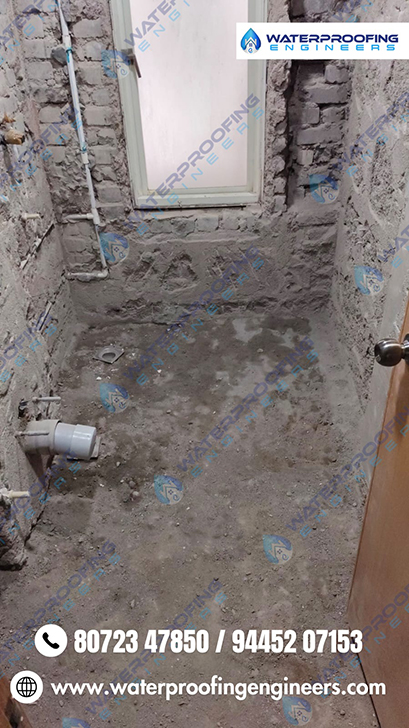 |
| Before Bathroom Renovation |
Detailed Site Condition, Observation & Leakage Analysis
During the inspection, we carefully observed that only the ceramic tile layer had been removed from the bathroom floor and walls. The underlying mortar bed and base layer were still intact and not dismantled.
In many renovation projects, there is a common misunderstanding that tile removal itself is enough to start waterproofing work. However, in professional waterproofing practice, internal waterproofing requires complete removal of the existing bedding layer up to the RCC slab level. Only then can a waterproof membrane or chemical coating properly bond with the structure.
In this particular site condition, applying internal waterproofing chemicals over the existing base would not provide reliable performance because:
The bonding surface is not fully exposed
Moisture may already be trapped inside the base layer
Chemical coating will not penetrate deeply
Long-term durability cannot be ensured
Therefore, we clearly explained to the client that internal waterproofing treatment was not recommended in this stage of renovation.
At Waterproofing Engineers, we always prioritize technical accuracy and long-term performance instead of suggesting short-term surface treatments that may fail later.
Waterproofing Engineers Analysis – Leakage Source Identification
As part of the inspection process, we also checked whether there were any leakage symptoms reported in the lower-floor apartment (9th floor), such as:
Ceiling damp patches
Water dripping marks
Wall discoloration
Paint peeling or blistering
The apartment owner confirmed that there were no such complaints from the unit below. This observation is very important in waterproofing diagnosis because slab leakage usually reflects in the lower-floor ceiling.
Based on this, we analyzed that the issue was not related to structural slab failure. Instead, the likely causes were:
Minor leakage through tile joints
Hidden plumbing line seepage
Gaps around bathroom fittings
Unsealed gully or outlet areas
This helped us narrow down the correct waterproofing approach without unnecessary demolition work.
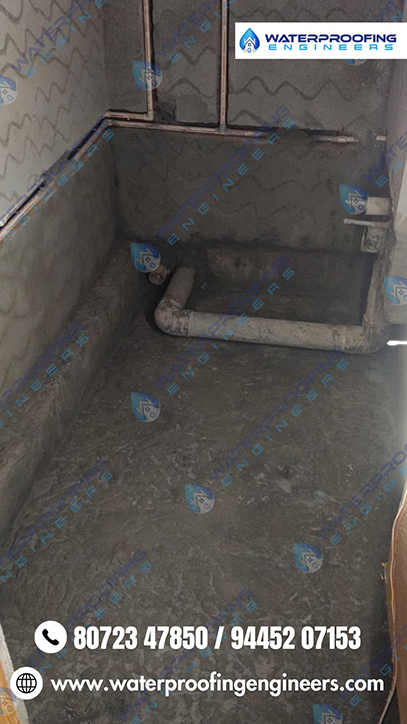 |
| Mother roof waterproofing (internal waterproofing process) |
Waterproofing Engineers – Recommended Practical Solution
Since internal waterproofing was not feasible in this condition, we recommended a controlled external waterproofing solution after tile installation is completed.
The proposed solution focuses on strengthening all weak entry points where water commonly penetrates in bathrooms.
Tile Joint Chemical Grouting Treatment
Tile joints are the most active seepage zones in bathrooms. Over time, grout becomes porous or weak due to continuous water exposure. By using epoxy-based chemical grouting, we can seal these joints effectively and prevent water from entering below the tile surface.
Gully Area Waterproof Packing Work
Bathroom drainage and gully points continuously handle water flow. If these areas are not properly sealed, water can slowly seep into surrounding concrete. Epoxy packing is used to tightly seal these drainage edges and prevent hidden leakage paths.
Door Frame Edge Waterproof Sealing
Bathroom door frame areas are often overlooked during construction. Small gaps between frame and wall can absorb moisture and gradually spread dampness into adjacent walls. Proper sealing around these edges helps stop moisture migration.
Joint and Corner Gap Treatment
Corners and junction points between floor and wall tiles are sensitive areas where micro gaps can form. These gaps are sealed using waterproof epoxy compounds to ensure no water penetration occurs even under continuous wet conditions.
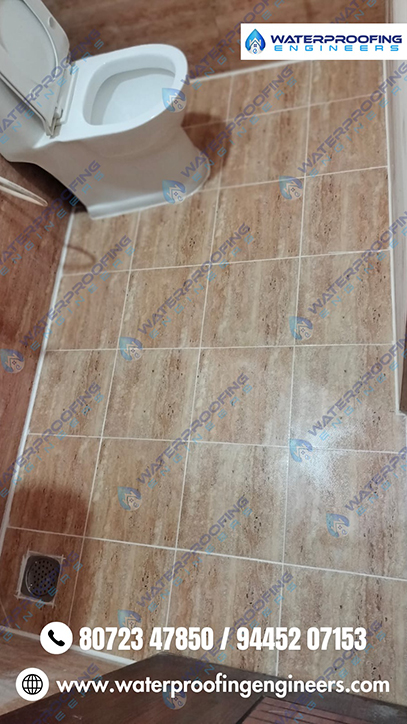 |
| After Bathroom Waterproofing |
Waterproofing Engineers Uses Advanced G-Epoxy Waterproofing Material
For this project, we recommended the use of high-performance G-Epoxy waterproofing material, which is prepared using:
Filler for gap filling strength
Resin for bonding and adhesion
Hardener for chemical curing and durability
Once mixed properly, this system forms a strong waterproof sealing layer that resists continuous water exposure and prevents joint failure.
This material is particularly effective for bathroom applications because it:
Bonds strongly with ceramic tile surfaces
Prevents water absorption in joints
Reduces chances of future leakage
Provides long-term durability in wet areas
Maintains stability under constant moisture exposure
Waterproofing Engineers Mandatory Tile Laying Instructions
During the site visit, we also provided an important technical instruction to the tile installation team regarding spacing.
We strongly recommended maintaining a 2mm spacer gap between all bathroom tiles during installation. This spacing is critical for proper epoxy grout application.
If tiles are placed without proper spacing:
Epoxy grout cannot penetrate fully into joints
Surface sealing becomes incomplete
Weak points may develop in the future
Water seepage risk increases significantly
After tile installation, epoxy grout should be carefully filled into all joints to ensure complete sealing and waterproof protection.
Bathroom Waterproofing Services – Cost Consideration in Chennai
The overall cost of waterproofing depends on several practical factors such as:
Bathroom total area and layout complexity
Number of joints requiring treatment
Extent of gully and edge packing required
Type and quantity of epoxy material used
Final grout color selection
In most residential bathroom projects, white epoxy grout is commonly preferred due to its clean finish and compatibility with modern tile designs.
Why Choose Waterproofing Engineers in Chennai
Waterproofing Engineers is one of the trusted waterproofing service providers in Chennai, offering specialized solutions for residential apartments, villas, commercial buildings, and industrial properties.
Our Services Include:
Bathroom waterproofing
Terrace waterproofing
Wall seepage treatment
Tile joint epoxy grouting
Water tank waterproofing
Crack filling solutions
External wall waterproof coating
Our experienced team focuses on identifying the root cause of leakage problems and providing practical, long-lasting waterproofing solutions.
Contact Waterproofing Engineers
Company Name: Waterproofing Engineers
Website: www.waterproofingengineers.com
Phone: 80723 47850 / 94452 07153
For expert bathroom waterproofing services in Chennai and accurate site-based technical consultation, contact Waterproofing Engineers for professional inspection and long-lasting waterproofing solutions.
Comments
Post a Comment